|
Figures & Portraits
|
|
 |
|
|
|
Price :
Contact Dealer
A Ralph Cahoon Painting of a Sailor holding a Cape Cod Painting with Mermaid and Girl, signed L.R. "R. Cahoon" oil on Swedish masonite Dimensions: 16 inches More »
A Ralph Cahoon Painting of a Sailor holding a Cape Cod Painting with Mermaid and Girl, signed L.R. "R. Cahoon" oil on Swedish masonite Dimensions: 16 inches ;by 20 inches. Reference: (http://en.wikipedia.org/wiki/Ralph_Cahoon) Early life Cahoon was born in Chatham, Massachusetts in 1910 to a family directly descended from the first Dutch Settlers of Cape Cod. Growing up close to the Atlantic Ocean, young Ralph spent many of his days sailing, fishing, digging clams, and sketching the coast. As he grew older, clamming and fishing slowly became secondary to his burgeoning interest in art. By the time he attended high school, he had started to apply his artistic interest and talent by taking a correspondence course in cartoon drawing and even submitted works to his school paper. Upon graduation Ralph attended Boston’s School of Practical Art where he focused primarily on commercial art, rather than his preference of decorative art. Frustrated with the ideological differences he encountered in art school, he returned to his native Cape Cod after his graduation. [edit]Career Cahoon''s young career took a dramatic turn in 1930 when he met and subsequently married (in 1932) a young Harwich woman named Martha Farham. The daughter of a well-respected and successful furniture decorator, Axel Farham, Martha introduced Ralph to the art of furniture decoration. Under her father’s tutelage Martha had become adept at free-hand decoration and introduced Ralph to the technique. After their marriage, the Cahoons moved to Osterville, and later to Cotuit where they would start a successful business decorating and selling antique furniture. In 1953 their careers took another twist when one of their customers, the wealthy New York socialite, art dealer, and future co-owner of the New York Mets, Joan Whitney Payson convinced them to frame some of their designs. Furthermore, Payson offered to show their works in her Long Island Gallery. Their foray from furniture decoration into “wall art” proved successful and both Cahoons went onto to produce numerous works over the ensuing decades. While much of their earlier furniture decoration shared the same Pennsylvania Dutch inspired motifs, their easel paintings marked the first significant diversion in Ralph and Martha’s palettes and styles. While Martha continued to work in muted tones, Ralph experimented with brighter and more contrasting colors. More importantly, Ralph developed the subject matter and style that made his paintings must haves for any distinguished family that summered on the Cape. Although he did not entirely abandon his Pennsylvania folk art roots, Ralph started painting whimsical scenes of sailors and mermaids frolicking on the backs of whales, in hot air balloons, on majestic ships, and countless other fantastic settings. As his commissions grew, Ralph would often incorporate his patron’s businesses, homes, or professions into the finished work along with the standard mermaids and sailors. In the end, Ralph Cahoon’s paintings were successful because they attracted a client base of wealthy, old money families that frequented vacationed or owned estates on the Cape or the Islands. The carefree, lighthearted antics portrayed in Ralph’s paintings appealed to patrons’ romantic associations with the Cape and were neither pretentious nor controversial. Ralph continued painting up until his death in 1982. Martha continued painting after Ralph’s death and even in her waning years continued to produce small crayon drawings up until her death in 1999. Today Ralph Cahoon’s paintings are highly sought after by collectors with his more important paintings exceeding $100,000 at public auction. The Cahoon Museum of American Art in Cotuit, Massachusetts features many of Cahoon''s works. [edit]References Peter Falk: Who Was Who in American Art Michael David Zellman: Three Hundred Years of American Art « Less
|
|
Figures & Portraits
|
|
Vendor Details
|
|
| ITEM IS NO LONGER AVAILABLE |
|
|
|
| Vendor Details |
Close |
| Contact Info : |
| Earle D. Vandekar of Knightsbridge Inc. |
| P.O. Box 586 |
| Downingtown |
| Pennsylvania-19335 |
| USA |
| Email : paul@vandekar.com |
| Phone : 212-308-2022 |
|
|
|
|
|
|
Price :
Contact Dealer
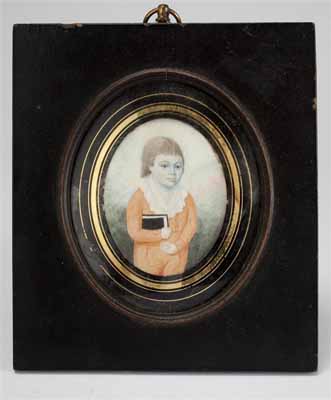
An Irish Portrait Miniature of a Boy Holding a Book, Circa 1800 The miniature, in its original rectangular wood and eglomise frame, depicts a young boy dressed in a red More »
An Irish Portrait Miniature of a Boy Holding a Book, Circa 1800 The miniature, in its original rectangular wood and eglomise frame, depicts a young boy dressed in a red outfit with a lace collar standing holding a peach in his left hand and a black book in his right. Dimensions: 2 3/8 x 2 inches. « Less
|
|
Figures & Portraits
|
|
Vendor Details
|
|
| ITEM IS NO LONGER AVAILABLE |
|
|
|
| Vendor Details |
Close |
| Contact Info : |
| Earle D. Vandekar of Knightsbridge Inc. |
| P.O. Box 586 |
| Downingtown |
| Pennsylvania-19335 |
| USA |
| Email : paul@vandekar.com |
| Phone : 212-308-2022 |
|
|
|
|
|
|
Price :
Contact Dealer
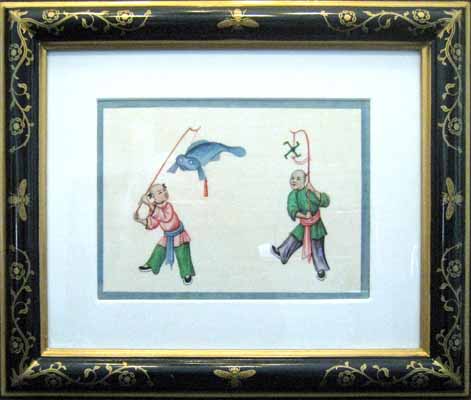
A Set of Twelve China Trade Pith Paper Pictures of Children Holding Lanterns, Circa 1860 The charming pictures are within a Chinese-style black and gold lacquered frame. More »
A Set of Twelve China Trade Pith Paper Pictures of Children Holding Lanterns, Circa 1860 The charming pictures are within a Chinese-style black and gold lacquered frame. Each picture depicts two children colourfully dressed holding different lanterns. Dimensions: Height: 14 1/2 inches x Length: 17 1/4 inches Provenance: O''Shea Gallery sold November 1994 « Less
|
|
Figures & Portraits
|
|
Vendor Details
|
|
| ITEM IS NO LONGER AVAILABLE |
|
|
|
| Vendor Details |
Close |
| Contact Info : |
| Earle D. Vandekar of Knightsbridge Inc. |
| P.O. Box 586 |
| Downingtown |
| Pennsylvania-19335 |
| USA |
| Email : paul@vandekar.com |
| Phone : 212-308-2022 |
|
|
|
|
|
|
Price :
Contact Dealer
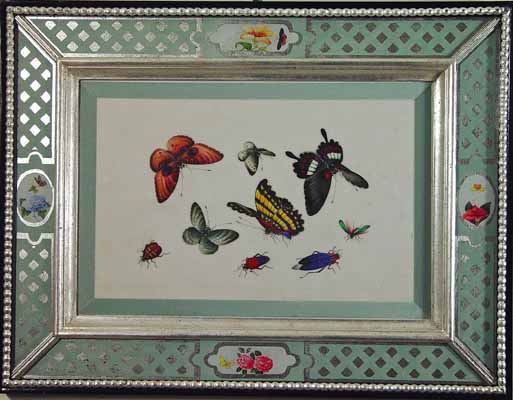
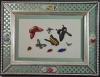
A Set of Six Chinese Watercolours of Butterflies and Insects, Circa 1850 The six watercolours are painted with butterflies and insects on pith paper within blue silk More »
A Set of Six Chinese Watercolours of Butterflies and Insects, Circa 1850 The six watercolours are painted with butterflies and insects on pith paper within blue silk ribbons. ;The frame is an aqua colour ground on an églomisé border with decoupage flowers. Dimensions: Height: 13 3/4 inches x width: 17 3/4 inches China Trade watercolours, although produced as early as the late 18th century, enjoyed the height of their popularity in the 1840’s and ‘50’s. ;Travels to China were difficult and expensive, and those from the West that could afford to make the journey did not wish to return empty-handed. Similar to the Grand Tour of the Continent, China was one of the ultimate elite destinations and anything of quality that was brought back immediately became status symbols. Watercolours, available in a variety of subjects and quite handsomely bound, were a popular choice not only due to their aesthetics, but also because of the ease of which they could be carried; large oil paintings and bulky ceramic objects did not lend themselves well to transport. Although a commodity produced for business, the watercolours were very well done, often by well-respected artists. Many of the artists did not work in watercolours often; one of the most respected artists at the time, Sunqua, painted primarily in oils. He worked in watercolor and gouache in the 1830’s- late 1840’s, producing albums and single paintings for export and trade during this time. He was an accomplished artist, whom Crossman says: “...would seem to belong to an Italian or European tradition of ship and port painting”, so good were his compositions and palettes. The first cultural exchanges appeared in the 16th century, when Italian Jesuit missionaries began filtering into China; as the literati widely rejected their Christian teachings, the Italians hurried to find another channel though which to forge bonds in the East. They began sending accomplished artists and teaching European painting techniques instead, forming a particular aesthetic that remained popular for centuries. The earliest China Trade pictures were produced on both Chinese and European paper; “Beginning in the 1780’s, the Chinese artists used western paper for most of their watercolours for the export trade… Supplying the Chinese with the raw materials for a product which was to be sold in the West was not unusual, since it occurred in many fields of manufacture. The other paper commonly used for watercolours and gouaches after 1800 or 1810, was pith, which has been mistakenly called ‘rice’ paper, both at that time and today…’ The so-called rice paper is made of the pith of the Aralia papyrifera. The pith is soaked before cutting; the workman then applies the blade to the cylinders of pith, and, turning them round dexterously, pares them from the circumference to the centre, making a rolled layer of equal thickness throughout’. The pith paper was a very fragile medium on which to work, and many of the watercolours on pith which have survived are cracked and broken.” The pictures were then mounted into albums with a silk ribbon, often blue but not always, and bound between boards covered with brightly coloured and patterned silk. Although it was extremely fragile, pith paper was widely favored due to its nature; the gouache used by the Chinese sat on the surface of the paper and produced a bright and sparkling effect. Very fine detail could be achieved whilst maintaining clean, vibrant colours. The material did not lend itself to the flat wash of colour favoured for European watercolours. Gouache, from the Italian guazzo, "water paint, splash") is a type of paint consisting of pigment suspended in water. Gouache differs from watercolour in that the particles are larger, the ratio of pigment to water is much higher and there is the presence of an inert white pigment, such as chalk. This makes gouache heavier and more opaque, with greater reflective qualities. Popular subjects included Chinese costumes, birds- often with richly painted backgrounds, fish, insects and junks and sampans. The shimmering paint served to heighten the exotic nature of the works, and the charming naiveté added to the perceived indigenous nature of the paintings. The art was made “…for strangers, strangers with an entirely different set of aesthetic presumptions and expectations, stands outside the major currents of art produced for a Chinese audience. It occupies a space which is neither wholly Chinese nor wholly European, but which can, by the nature of the compromises it makes, tell us a lot about how one culture saw the other in the age before photography. It did not exist separately from, but rather as an integral part of, the relationship between China and the West…” Although produced in the mid-19th century, the works remain as naïve, exotic and desirable now as they did when seen for the first time. « Less
|
|
Figures & Portraits
|
|
Vendor Details
|
|
| ITEM IS NO LONGER AVAILABLE |
|
|
|
| Vendor Details |
Close |
| Contact Info : |
| Earle D. Vandekar of Knightsbridge Inc. |
| P.O. Box 586 |
| Downingtown |
| Pennsylvania-19335 |
| USA |
| Email : paul@vandekar.com |
| Phone : 212-308-2022 |
|
|
|
|
|
|
Price :
Contact Dealer
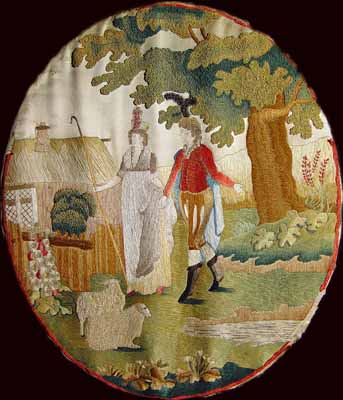
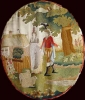
An English Regency Large Oval Silk and Wool Picture, Circa 1780-1820 The silkwork in deep rich colours depict a gallant and a lady standing by a thatched cottage and More »
An English Regency Large Oval Silk and Wool Picture, Circa 1780-1820 The silkwork in deep rich colours depict a gallant and a lady standing by a thatched cottage and tree with a field of wheat behind. ;In the foreground are two sheep. ;The lady is dressed as a shepherdess and the man wears black boots, brown pants and a bright red jacket. ;He wears a a feathered hat on his head. Great colour and condition- one small tear to upper left. ; Height: 17 1/2 framed « Less
|
|
Figures & Portraits
|
|
Vendor Details
|
|
| ITEM IS NO LONGER AVAILABLE |
|
|
|
| Vendor Details |
Close |
| Contact Info : |
| Earle D. Vandekar of Knightsbridge Inc. |
| P.O. Box 586 |
| Downingtown |
| Pennsylvania-19335 |
| USA |
| Email : paul@vandekar.com |
| Phone : 212-308-2022 |
|
|
|
|
|
|
Price :
Contact Dealer
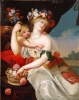
A Fine Portrait Miniature of Anna Maria Nickel as "Flora" and her eldest son Johann Heinrich Nickel as a boy, After The Janssens original called Allegory of More »
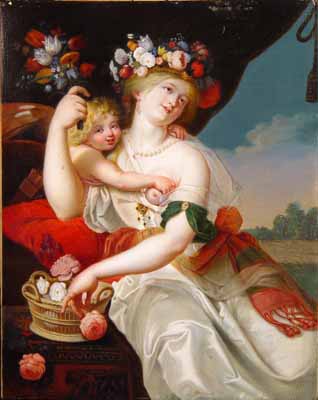
A Fine Portrait Miniature of Anna Maria Nickel as "Flora" and her eldest son Johann Heinrich Nickel as a boy, After The Janssens original called Allegory of Spring, by Franz Nickel (1783-1845) The miniature is painted in an Old Master style possibly after an actual painting. ;She is sitting with a bouquet of flowers in her right hand which rests upon a red cushion with her left hand retrieving a pink rose from a wicker basket by her right side. ;She wears an ornate hat covered with live flowers. In the background is a rural landscape of a field and woods beyond. ;A theatrical curtain crosses behind her. ;Her young son is draped across her right arm with his arm resting on her exposed breast. On the backing board are two old labels. ;One is now almost completely missing with the words Flora mi Anor(?) and a second which reads.....Franz Nichel (1783-1845) Dimensions: Miniature: 6 3/4 inches x 5 3/4 inches On an attached sheet a family history which reads as follows- "Allegorial Picture of Anna Maria Nickel as "Flora" and her eldest son Johann Heinrich Nickel as boy painted on Ivory by her husband Franz Nickel (1783-1845) Son: ;Johann Heinrich Nchel Daughter Maria Canthal nee Nickel Granddaughter: Emy Engelhard nee Canthal Greatgrandson: Charles W. Engelhard Greatgreatgranddaughters: Mary Suzan Engelhard Sophie Jane ; ; ; ; ; ; ; ; ; ; ;" Sally Alexandra ; ; ; ;" Charline Barry ; ; ; ; ;" ;" Provenance: ;Mrs. Charles Engelhard Reference: The Miniature in Europe, Vol II, Leo R. Schidlof, page 590. Franz Nickel Born in Hanou 25th December 1783, died in the same town 1845. ;Painted on enamel, who worked in Hanau and in Madrid, where he was for a long time assistant at the Academy. Nickel was an artist of quality. ; ABRAHAM JANSSEN II (Antwerp 1616 - after 1668) ;Allegory of Spring Oil on panel 48 ½ x 36 ¾ in. (123.2 x 93.3 cm.) Provenance: ;Anon. sale, Lepke, Berlin, 8 May 1906; with F. Gurlitt, Berlin. Literature: ;To be included in the forthcoming catalogue raisonné of works by Abraham Janssen the Elder currently being prepared by Dr. Joost Vander Auwera (to be published in 2005). Iconographically the voluptuous female in this Allegory of Spring appears to be a combination of two goddesses, Venus and Flora. The ancient Italian goddess of flowers, Flora was the Roman equivalent of the Greek goddess Chloris, wife of Zephyr, the west wind of springtime, who begets flowers. ;The depiction here corresponds quite closely to the description given in Cesare Ripa’s Iconologia of 1603. Ripa writes that Flora could be used to represent Spring, citing a description from Ovid’s Metamorphoses: ‘Crowned with flowers and surrounded by white, red and yellow blooms, her beautiful face was rosy and milky in complexion, her teeth like pearls and her lips like coral.’11 ‘Di rose, e latte, è la sua faccia e bella, son perle i denti, e le labra coralli.’; op. cit., Rome, 1603, New York, 1984 ed., p. 474. The inclusion of Cupid suggests the figure might also be identifiable as Venus, the goddess of love. Ripa refers to the ‘lascivi amori’ of spring, and the suggestive way in which Cupid touches her breast makes explicit the sensuality associated with this season. Until recently this Allegory of Spring was considered the work of Abraham Janssen van Nuyssen the Elder (c.1571/75-1632), one of the leading artists in Antwerp in the early seventeenth-century. Now, however, an attribution to his son and pupil Abraham Janssen II ; ;(1616 - after 1668) may be advanced. Janssen the Younger’s artistic personality has only begun to emerge in recent years and will be covered in the forthcoming catalogue raisonné of works by Abraham Janssen the Elder currently being prepared by Dr. Joost Vander Auwera.22 To be published in 2005 by Brepols Publishers, Turnhout and Macmillan, London. ;Like his father, Abraham Janssen the Younger visited Rome (1639-1649), where he was able to study antique sculpture and the art of Michelangelo and Raphael. Significantly however, he visited Italy a generation later than his father and he did not adopt the latter’s sculptural or even Caravaggesque approach to the human figure. He chose instead to work in the more elegant, pictorial idiom that had come to prevail in northern Europe under the influence of Rubens and van Dyck.33 This shift from the Caravaggesque idiom to the Rubensian mode can be seen clearly in the art of Gerard Seghers. The starting point for the reconstruction of Janssen the Younger’s oeuvre is the Adoration of the Magi in the parish church of St. Wilmart, in the small village of Lesve near Profondeville in the Belgian Ardennes. This canvas is signed ‘A Janssen’ and dated ‘1636’, i.e. four years after the death of Janssen senior, and has thus been securely attributed to his son by Vander Auwera. Although Janssen also had a daughter, Anna Maria, who was a painter in her own right, her signed works are different in style to the Lesve Adoration.44 The works of Anna Maria, who was the wife of Jan Brueghel the Younger, have, like her brother’s, ;often been confused with those of their father. ;Her oeuvre has also been reconstructed by Dr. Vander Auwera. The Colnaghi Allegory shows some stylistic parallels with this Adoration. The physiognomy of the figure of Cupid is, for example, close to the young attendants of the Magi. It is, however, also true to say that something of Janssen the Elder’s sculptural approach to the human figure can also be detected in our work. It is possible that the flowers in our painting are by Anna Maria, who painted a number of signed still lifes.55 See, for example, the still life formerly with P. de Boer (J de Maere & M. Wabbes, Illustrated Dictionary of 17th-century Flemish Painters, Brussels, 1994, II, p. 649). Autographed works by Janssen the Younger such as this and the Lesve painting are rare. They probably date to the years 1636-39, that is, after the artist had become a master of the Antwerp guild and set up his own studio, and before his departure for Italy in 1639. His style at this time seems to have been influenced by contemporary artistic developments in Paris, where the art dealing family of his father’s wife, the Goetkint (also known as Bonenfants), was very much involved in the Saint Germain fair. The Lesve painting, for example, is stylistically close to an Adoration of the Magi of c.1626-29 attributed to Georges Lallemand (c.1575-1636), an artist from Lorraine working in Paris.66 Palais des Beaux-Arts, Lille, inv. no. P 322. His earlier works also recall those of Pieter Van Lint (1609-1690), who may have taught Janssen after his father’s death in 1632. A number of versions closely related to our picture are also known, something that attests to the popularity of the composition.77 These include: one at Lepke, Berlin, 13 April 1908, lot 116 (as Flemish School; oil on canvas); another sold, with an Allegory of Autumn, Sotheby’s, New York, 14 October 1992, lot 104, as attributed to Janssen I; and two works recorded at the Witt Library, London, one in Mainz, the other in the Acton Collection, Florence. In the Berlin and Acton compositions, Venus’s breast is covered. It is likely that it also once formed part of a series depicting the Four Seasons – many such series were probably produced in the studio of Janssen the Elder, and then later in the workshop that his son ran following his return from Italy in 1649. A number of compositions of comparable dimensions and with similar three-quarter-length female figures depicting other seasons of the year are known.88 Among these are: an Allegory of Autumn (sold, Christie’s, New York, 31 May 1991, lot 46, as Abraham Janssen I); an Allegory of Spring (a different composition to our work) and an Allegory of Summer (sold, Christie’s, New York, 16 January 1992, lot 31, as circle of Janssen); and another Allegory of Spring (again different to ours), offered for sale, Deurbergue and Delvaux, Paris, 15 November 1991, lot 12, as Abraham Janssen I and Jan Breughel II. ; ; ; « Less
|
|
Figures & Portraits
|
|
Vendor Details
|
|
| ITEM IS NO LONGER AVAILABLE |
|
|
|
| Vendor Details |
Close |
| Contact Info : |
| Earle D. Vandekar of Knightsbridge Inc. |
| P.O. Box 586 |
| Downingtown |
| Pennsylvania-19335 |
| USA |
| Email : paul@vandekar.com |
| Phone : 212-308-2022 |
|
|
|
|
|
|

Price :
Contact Dealer
A FINE SHELLWORK PICTURE, Circa 1820-40. The rectangular picture with a central reserve depicting naval objects including flags, drums, anchors, medals and cannon, all More »
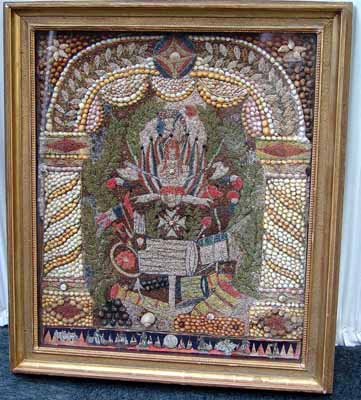
A FINE SHELLWORK PICTURE, Circa 1820-40. The rectangular picture with a central reserve depicting naval objects including flags, drums, anchors, medals and cannon, all depicted with tiny shell seeds. ;The surround also in shells in the form of columns. ;Along the foot are applied paper figures including the Gin Woman, Englishman, Almanacks, Live Lobsters and other figures. ;Dimensions: 24 x 21 1/2 inches « Less
|
|
Figures & Portraits
|
|
Vendor Details
|
|
| ITEM IS NO LONGER AVAILABLE |
|
|
|
| Vendor Details |
Close |
| Contact Info : |
| Earle D. Vandekar of Knightsbridge Inc. |
| P.O. Box 586 |
| Downingtown |
| Pennsylvania-19335 |
| USA |
| Email : paul@vandekar.com |
| Phone : 212-308-2022 |
|
|
|
|
|
|
Price :
Contact Dealer
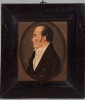
An English Portrait Miniature of a Gentleman, On Board, Circa 1820-35. The rectangular miniature painted on board depicts a country gentleman in profile wearing a brown More »
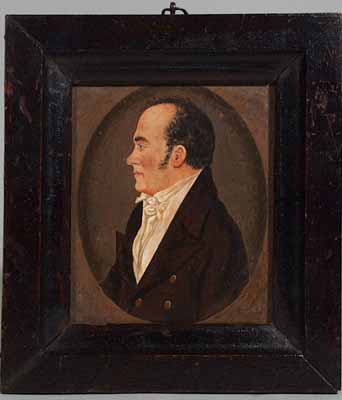
An English Portrait Miniature of a Gentleman, On Board, Circa 1820-35. The rectangular miniature painted on board depicts a country gentleman in profile wearing a brown jacket with brass buttons and a white shirt and white cravat. ;His hair recedes in the front and is curly. ;He wears long side burns to below his ears.. ;The portrait is painted within a darker oval with olive green to the outer edge. The portrait is in a wood frame. Dimensions: 7 1/4 x 6 3/4 inches « Less
|
|
Figures & Portraits
|
|
Vendor Details
|
|
| ITEM IS NO LONGER AVAILABLE |
|
|
|
| Vendor Details |
Close |
| Contact Info : |
| Earle D. Vandekar of Knightsbridge Inc. |
| P.O. Box 586 |
| Downingtown |
| Pennsylvania-19335 |
| USA |
| Email : paul@vandekar.com |
| Phone : 212-308-2022 |
|
|
|
|
|
|
Price :
$7500.00
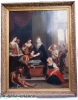
Item #2315. After Bartolome Esteban Murillo (Spanish, 1617-1682) St. Elizabeth of Hungary Tending the Sick and Leprous", third quarter 19th-century oil on canvas. Presented More »
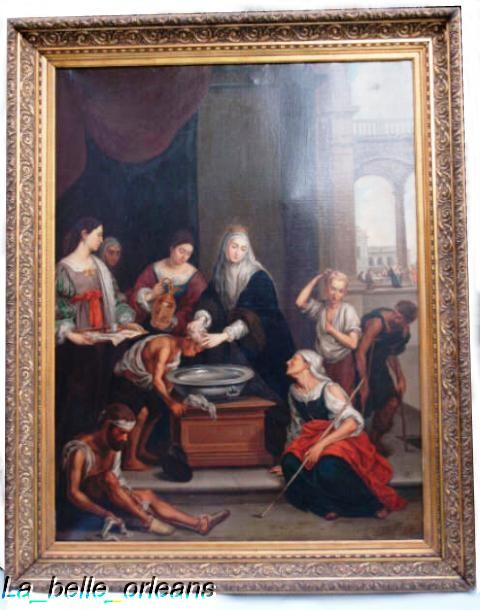
Item #2315. After Bartolome Esteban Murillo (Spanish, 1617-1682) St. Elizabeth of Hungary Tending the Sick and Leprous", third quarter 19th-century oil on canvas. Presented in a period carved giltwood and plaster frame in the rococo style. . CONDITION: The frame is in excellent shape for age with normal wear. The canvas is in very good shape, with an old repair that can see only looking from it;s back. A fine piece of religious art to add to your collection!! MEASURES: 58" HIGH X 46 1/2" WIDE (FRAME). 49" HIGH X 37 1/2" WIDE (CANVAS). European, late 19th century.IMPORTANT: This item is in our warehouse in New Orleans at the time of the auction READY TO BE SHIPPED OR PICKED UP!!! Contact us with all your questions BEFORE placing your bids. Thanks for looking and Good Luck!!!La Belle Nouvelle Orleans is a 10,000 square ft. store located in the heart of Uptown New Orleans. Our inventory consists of a wide variety of European furniture including armoires, tables, sets of chairs, bedroom sets, showcases, lighting, bric-a-brac, etc. We also carry a very large architectural inventory which includes gates, wrought iron railings and panels, stained glass, doors, windows, etc. Our shipments arrive every month from all over the world. Don't miss our other auctions and thanks for looking and bidding. GOOD LUCK!!!!! « Less
|
|
Figures & Portraits
|
|
Vendor Details
|
|
| ITEM IS NO LONGER AVAILABLE |
|
|
|
| Vendor Details |
Close |
| Contact Info : |
| La Belle Nouvelle Orleans Antiques |
| 2112 Magazine St. |
| New Orleans |
| Louisiana-70130 |
| USA |
| Email : fernando@labellenouvelle.nocoxmail.com |
| Phone : 504-581-3733. |
|
|
|
|
|
|
Price :
$350.00
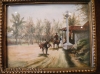
#2213. A fine Antique french miniature painting. Depicting a rural scene with man on hoarse and two ladies sitting in a porch . Great details in trees, background with old More »
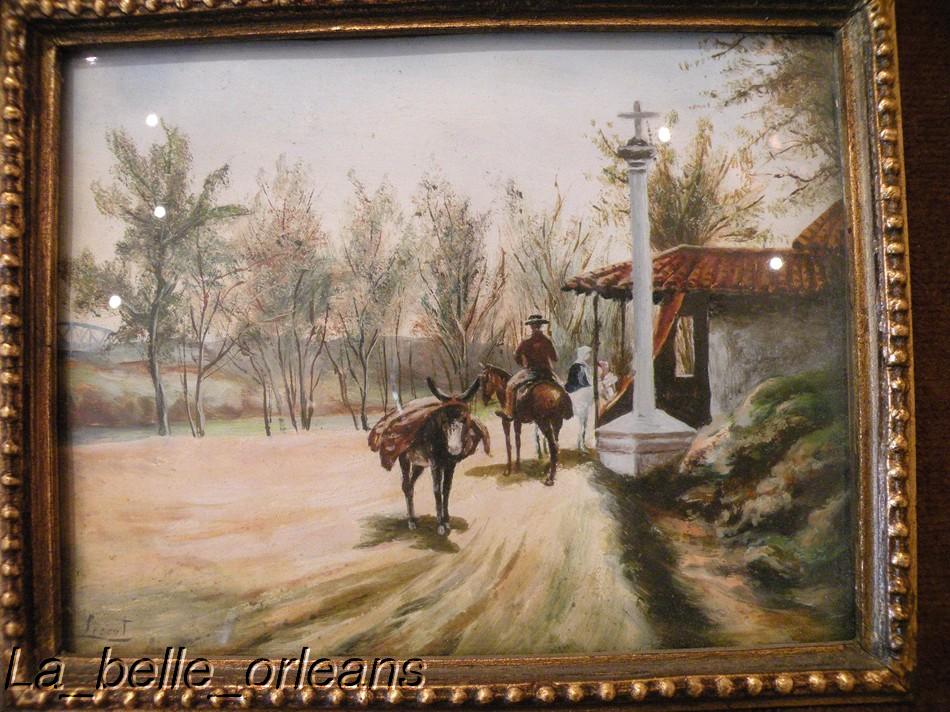
#2213. A fine Antique french miniature painting. Depicting a rural scene with man on hoarse and two ladies sitting in a porch . Great details in trees, background with old train bridge. Signed on the lower right corner " LESCOT" . In original gilded frame frame wood, gesso and velvet . Dates to the early 1900's. Glass cover . Paint looks like oil on paper or cardboard. Painting measures 6" x 4 1/2" . Frame is 11" x 10". Two minor chips to frame.NOTE: Pictures were taken both with and without flash light so you can see the tone of the patina with different types of light. Describing colors can be tricky so we try to take the best pictures we can.IMPORTANT: This item is in our warehouse in New Orleans at the time of the auction READY TO BE SHIPPED OR PICKED UP!!! Contact us with all your questions BEFORE Placing your bids. Thanks for looking and GOOD LUCK!!!!!La Belle Nouvelle Orleans is a 10,000 square ft. store located in the heart of Uptown New Orleans. Our inventory consists of a wide variety of European furniture including armoires, tables, sets of chairs, bedroom sets, showcases, lighting, bric-a-brac, etc. We also carry a very large architectural inventory which includes gates, wrought iron railings and panels, stained glass, doors, windows, etc. Our shipments arrive every month from all over the world. Don't miss our other auctions and thanks for looking and bidding. GOOD LUCK!!!!! « Less
|
|
Figures & Portraits
|
|
Vendor Details
|
|
| ITEM IS NO LONGER AVAILABLE |
|
|
|
| Vendor Details |
Close |
| Contact Info : |
| La Belle Nouvelle Orleans Antiques |
| 2112 Magazine St. |
| New Orleans |
| Louisiana-70130 |
| USA |
| Email : fernando@labellenouvelle.nocoxmail.com |
| Phone : 504-581-3733. |
|
|
|
|
|
|
|
|

|