|
Contemporary Designs
|
|
 |
|
|
|

Price :
$3800.00
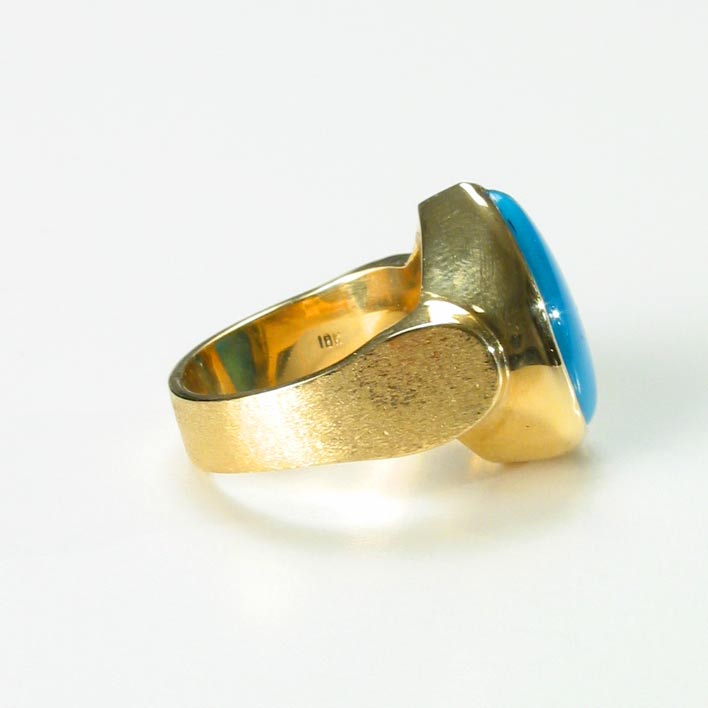
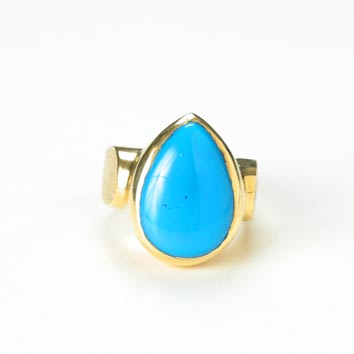
A gem of celestial blue beauty, turquoise ("the Turkish stone") has been prized as adornment and sought after as a talisman throughout the ages and all over the world. A More »
A gem of celestial blue beauty, turquoise ("the Turkish stone") has been prized as adornment and sought after as a talisman throughout the ages and all over the world. A complex phosphate of aluminum and copper, which ranges in color from bright blue to green to gray, turquoise is mined mostly in arid regions with sedimentary and fractured volcanic rocks. The Pharaohs of Egypt left inscriptions recording their successful turquoise mining in the Sinai desert, while the Indians of the American Southwest--who considered it a sacred stone-- found their sources chiefly in New Mexico and Arizona. Turquoise occurs in a wide area of the Near East and Europe, and its use in jewelry and amulets dates from the 5th millennium before Christ. The Egyptians particularly valued it as a bringer of luck, in which capacity it is still used throughout the Middle East. In the Americas, it was considered an essential possession for a medicine man, and was used extensively as adornment, as it still is today. Ancient Indian burial sites have yielded up thousands of turquoise beads used to decorate the deceased. Its power as a charm of good fortune is thought to be unrivaled because of its lucky blue color; it is believed to protect the wearer from accidents and falls. Therapeutically, the gem is useful for freeing the body from toxins, preventing arthritis, curing eye diseases, and relieving urinary disorders. To wear turquoise is to wear the sky on a bright and sunny day. - (FJ.2851)Origin: Arizona Collection: Gem Stone Rings Style: Turquoise Ring Medium: Turquoise and Gold « Less
|
|
Contemporary Designs
|
|
|
|
|
| Vendor Details |
Close |
| Contact Info : |
| Barakat Gallery |
| 405 North Rodeo Drive |
| Beverly Hills |
| California-90210 |
| USA |
| Email : barakat@barakatgallery.com |
| Phone : 310.859.8408 |
|
|
|
|
|
|
Price :
$2600.00
A gem of celestial blue beauty, turquoise ("The Turkish Stone") has been prized as adornment and sought after as a talisman throughout the ages and allover the world. A More »
A gem of celestial blue beauty, turquoise ("The Turkish Stone") has been prized as adornment and sought after as a talisman throughout the ages and allover the world. A complex phosphate of aluminum and copper, which ranges in color from bright blue, to green, to gray, turquoise is mined mostly in arid regions with sedimentary and fractured volcanic rocks. The Pharaohs of Egypt left inscriptions recording their successful turquoise mining in the Sinai desert, while the Indians of the American Southwest-- who considered it a sacred stone-found their sources chiefly in New Mexico and Arizona. Turquoise occurs in a wide area of the Near East and Europe, and its use in jewelry and amulets dates from the 5th millennium before Christ. The Egyptians particularly valued it as a bringer of luck, in which capacity it is still used throughout the Middle East. In the Americas, it was considered an essential possession for a medicine man, and was used extensively as adornment, as it still is today. Ancient Indian burial sites have yielded up thousands of turquoise beads used to decorate the deceased. Its power as a charm of good fortune is thought to be unrivaled because of its lucky blue color; it is believed to protect the wearer from accidents and falls. Therapeutically, the gem is useful for freeing the body from toxins, preventing arthritis, curing eye diseases, and relieving urinary disorders. To wear turquoise is to wear the sky on a bright and sunny day. - (FJ.5603)Origin: Arizona Collection: Turquoise Ring Medium: Turquoise/Gold « Less
|
|
Contemporary Designs
|
|
|
|
|
| Vendor Details |
Close |
| Contact Info : |
| Barakat Gallery |
| 405 North Rodeo Drive |
| Beverly Hills |
| California-90210 |
| USA |
| Email : barakat@barakatgallery.com |
| Phone : 310.859.8408 |
|
|
|
|
|
|

Price :
$2400.00
A gem of celestial blue beauty, turquoise ("The Turkish Stone") has been prized as adornment and sought after as a talisman throughout the ages and allover the world. A More »
A gem of celestial blue beauty, turquoise ("The Turkish Stone") has been prized as adornment and sought after as a talisman throughout the ages and allover the world. A complex phosphate of aluminum and copper, which ranges in color from bright blue, to green, to gray, turquoise is mined mostly in arid regions with sedimentary and fractured volcanic rocks. The Pharaohs of Egypt left inscriptions recording their successful turquoise mining in the Sinai desert, while the Indians of the American Southwest-- who considered it a sacred stone-found their sources chiefly in New Mexico and Arizona. Turquoise occurs in a wide area of the Near East and Europe, and its use in jewelry and amulets dates from the 5th millennium before Christ. The Egyptians particularly valued it as a bringer of luck, in which capacity it is still used throughout the Middle East. In the Americas, it was considered an essential possession for a medicine man, and was used extensively as adornment, as it still is today. Ancient Indian burial sites have yielded up thousands of turquoise beads used to decorate the deceased. Its power as a charm of good fortune is thought to be unrivaled because of its lucky blue color; it is believed to protect the wearer from accidents and falls. Therapeutically, the gem is useful for freeing the body from toxins, preventing arthritis, curing eye diseases, and relieving urinary disorders. To wear turquoise is to wear the sky on a bright and sunny day. - (FJ.5615)Origin: Arizona Collection: Turquoise Rings Medium: Turquoise/Gold « Less
|
|
Contemporary Designs
|
|
|
|
|
| Vendor Details |
Close |
| Contact Info : |
| Barakat Gallery |
| 405 North Rodeo Drive |
| Beverly Hills |
| California-90210 |
| USA |
| Email : barakat@barakatgallery.com |
| Phone : 310.859.8408 |
|
|
|
|
|
|

Price :
$2800.00
This Gorgeous Gemstone Has Been Set in a Modern 18 Karat Gold Ring The word turquoise literally means, “Turkish stone,†reflecting the trade route that first More »
This Gorgeous Gemstone Has Been Set in a Modern 18 Karat Gold Ring The word turquoise literally means, “Turkish stone,†reflecting the trade route that first exposed this light blue stone to the Europeans. Ancient Arabians called turquoise, “fayruz,†meaning, “lucky stone.†In fact, turquoise is considered a “lucky†stone by an astonishing array of cultures, including the Southwestern American Indians, Arabic and Turkish cultures, and Indian Hindus. The American Indians of Southwest highly prized turquoise, even using the stone as units of exchange. They ground it into powder for use in sand paintings and native magical ceremonies. Furthermore, turquoise is heralded for its protective powers, believed to thwart the evil forces of black magic. If a piece of turquoise is placed on the saddle or bridal, as well as one held on the rider, turquoise is said to protect equestrians and their horses. A rare, pure blue color is treasured, for most pieces contain turquoise matrix, which may be brown, dark gray, or black. Many legends also exist concerning the bluish hue. Muslims believe that if the color changes, it signals a straying woman. This echoes the notion that if turquoise is given as a gift of love and the color fades, it means the love is also fading. Many Europeans also believed that as one grows older, the stone loses it color; yet if the stone is passed onto a younger individual, the turquoise will regain its characteristic color. Turquoise is recognized by several diverse cultures not only for its inherent beauty, but also for its beneficial powers, able to bring good fortune and protection to those lucky enough to wear it. While this stone is completely natural, its color has been enhanced chemically. - (FJ.6941)Origin: Arizona Medium: Turquoise-Gold « Less
|
|
Contemporary Designs
|
|
|
|
|
| Vendor Details |
Close |
| Contact Info : |
| Barakat Gallery |
| 405 North Rodeo Drive |
| Beverly Hills |
| California-90210 |
| USA |
| Email : barakat@barakatgallery.com |
| Phone : 310.859.8408 |
|
|
|
|
|
|

Price :
$2500.00
This Gorgeous Gemstone Has Been Set in a Modern 18 Karat Gold Ring The word turquoise literally means, “Turkish stone,†reflecting the trade route that first More »
This Gorgeous Gemstone Has Been Set in a Modern 18 Karat Gold Ring The word turquoise literally means, “Turkish stone,†reflecting the trade route that first exposed this light blue stone to the Europeans. Ancient Arabians called turquoise “fayruz,†meaning, “lucky stone.†In fact, turquoise is considered a “lucky†stone by an astonishing array of cultures, including the Southwestern American Indians, Arabic and Turkish cultures, and Indian Hindus. The American Indians of Southwest highly prized turquoise, even using the stone as units of exchange. They ground it into powder for use in sand paintings and native magical ceremonies. Furthermore, turquoise is heralded for its protective powers, believed to thwart the evil forces of black magic. If a piece of turquoise is placed on the saddle or bridal, as well as one held on the rider, turquoise is said to protect equestrians and their horses. A rare, pure blue color is treasured, for most pieces contain turquoise matrix, which may be brown, dark gray, or black. Many legends also exist concerning the bluish hue. Muslims believe that if the color changes, it signals a straying woman. This echoes the notion that if turquoise is given as a gift of love and the color fades, it means the love is also fading. Many Europeans also believed that as one grows older, the stone loses it color; yet if the stone is passed onto a younger individual, the turquoise will regain its characteristic color. Turquoise is recognized by several diverse cultures not only for its inherent beauty, but also for its beneficial powers, able to bring good fortune and protection to those lucky enough to wear it. While this stone is completely natural, its color has been enhanced chemically. - (FJ.6943)Origin: Arizona Medium: Turquoise-Gold « Less
|
|
Contemporary Designs
|
|
|
|
|
| Vendor Details |
Close |
| Contact Info : |
| Barakat Gallery |
| 405 North Rodeo Drive |
| Beverly Hills |
| California-90210 |
| USA |
| Email : barakat@barakatgallery.com |
| Phone : 310.859.8408 |
|
|
|
|
|
|

Price :
$5000.00
The word turquoise literally means, “Turkish stone,†reflecting the trade route that first exposed this light blue stone to the Europeans. Ancient Arabians called More »
The word turquoise literally means, “Turkish stone,†reflecting the trade route that first exposed this light blue stone to the Europeans. Ancient Arabians called turqoiuse “fayruz,†meaning, “lucky stone.†In fact, turquoise is considered a “lucky†stone by an astonishing array of cultures, including the Southwestern American Indians, Arabic and Turkish cultures, and Indian Hindus. The Indians of the American Southwest highly prized turquoise, even using the stone as units of exchange. They ground it into powder for use in sand paintings and native magical ceremonies. Furthermore, turquoise is heralded for its protective powers, believed to thwart the evil forces of black magic. If a piece of turquoise is placed on the saddle or bridal, as well as one held on the rider, turquoise is said to protect equestrians and their horses. A rare, pure blue color is treasured, for most pieces contain turquoise matrix, which may be brown, dark gray, or black. Many legends also exist concerning the bluish hue. Muslims believe that if the color changes, it signals a straying woman. This echoes the notion that if turquoise is given as a gift of love and the color fades, it means the love is also fading. Many Europeans also believed that as one grows older, the stone loses it color; yet if the stone is passed onto a younger individual, the turquoise will regain its characteristic color. Turquoise is recognized by several diverse cultures not only for its inherent beauty, but also for its beneficial powers, able to bring good fortune and protection to those lucky enough to wear it. - (FJ.7128)Origin: Arizona, USA Collection: Jewelry Medium: Turquoise and Gold « Less
|
|
Contemporary Designs
|
|
|
|
|
| Vendor Details |
Close |
| Contact Info : |
| Barakat Gallery |
| 405 North Rodeo Drive |
| Beverly Hills |
| California-90210 |
| USA |
| Email : barakat@barakatgallery.com |
| Phone : 310.859.8408 |
|
|
|
|
|
|

Price :
$4600.00
The word turquoise literally means, “Turkish stone,†reflecting the trade route that first exposed this light blue stone to the Europeans. Ancient Arabians called More »
The word turquoise literally means, “Turkish stone,†reflecting the trade route that first exposed this light blue stone to the Europeans. Ancient Arabians called turqoiuse “fayruz,†meaning, “lucky stone.†In fact, turquoise is considered a “lucky†stone by an astonishing array of cultures, including the Southwestern American Indians, Arabic and Turkish cultures, and Indian Hindus. The Indians of the American Southwest highly prized turquoise, even using the stone as units of exchange. They ground it into powder for use in sand paintings and native magical ceremonies. Furthermore, turquoise is heralded for its protective powers, believed to thwart the evil forces of black magic. If a piece of turquoise is placed on the saddle or bridal, as well as one held on the rider, turquoise is said to protect equestrians and their horses. A rare, pure blue color is treasured, for most pieces contain turquoise matrix, which may be brown, dark gray, or black. Many legends also exist concerning the bluish hue. Muslims believe that if the color changes, it signals a straying woman. This echoes the notion that if turquoise is given as a gift of love and the color fades, it means the love is also fading. Many Europeans also believed that as one grows older, the stone loses it color; yet if the stone is passed onto a younger individual, the turquoise will regain its characteristic color. Turquoise is recognized by several diverse cultures not only for its inherent beauty, but also for its beneficial powers, able to bring good fortune and protection to those lucky enough to wear it. - (FJ.7127)Origin: Arizona, USA Collection: Jewelry Medium: Turquoise and Gold « Less
|
|
Contemporary Designs
|
|
|
|
|
| Vendor Details |
Close |
| Contact Info : |
| Barakat Gallery |
| 405 North Rodeo Drive |
| Beverly Hills |
| California-90210 |
| USA |
| Email : barakat@barakatgallery.com |
| Phone : 310.859.8408 |
|
|
|
|
|
|

Price :
$4600.00
This genuine gem stone has been set in a modern 18 karat gold ring. The word turquoise literally means, “Turkish stone,†reflecting the trade route that first More »
This genuine gem stone has been set in a modern 18 karat gold ring. The word turquoise literally means, “Turkish stone,†reflecting the trade route that first exposed this light blue stone to the Europeans. Ancient Arabians called turqoiuse “fayruz,†meaning, “lucky stone.†In fact, turquoise is considered a “lucky†stone by an astonishing array of cultures, including the Southwestern American Indians, Arabic and Turkish cultures, and Indian Hindus. The Indians of the American Southwest highly prized turquoise, even using the stone as units of exchange. They ground it into powder for use in sand paintings and native magical ceremonies. Furthermore, turquoise is heralded for its protective powers, believed to thwart the evil forces of black magic. If a piece of turquoise is placed on the saddle or bridal, as well as one held on the rider, turquoise is said to protect equestrians and their horses. A rare, pure blue color is treasured, for most pieces contain turquoise matrix, which may be brown, dark gray, or black. Many legends also exist concerning the bluish hue. Muslims believe that if the color changes, it signals a straying woman. This echoes the notion that if turquoise is given as a gift of love and the color fades, it means the love is also fading. Many Europeans also believed that as one grows older, the stone loses it color; yet if the stone is passed onto a younger individual, the turquoise will regain its characteristic color. Turquoise is recognized by several diverse cultures not only for its inherent beauty, but also for its beneficial powers, able to bring good fortune and protection to those lucky enough to wear it. - (FJ.7126)Origin: Arizona, USA Collection: Jewelry Style: Gem Stone Rings Medium: Turquoise and Gold « Less
|
|
Contemporary Designs
|
|
|
|
|
| Vendor Details |
Close |
| Contact Info : |
| Barakat Gallery |
| 405 North Rodeo Drive |
| Beverly Hills |
| California-90210 |
| USA |
| Email : barakat@barakatgallery.com |
| Phone : 310.859.8408 |
|
|
|
|
|
|

Price :
$2800.00
The word turquoise literally means, “Turkish stone,†reflecting the trade route that first exposed this light blue stone to the Europeans. Ancient Arabians called More »
The word turquoise literally means, “Turkish stone,†reflecting the trade route that first exposed this light blue stone to the Europeans. Ancient Arabians called turquoise “fayruz,†meaning, “lucky stone.†In fact, turquoise is considered a “lucky†stone by an astonishing array of cultures, including the Southwestern American Indians, Arabic and Turkish cultures, and Indian Hindus. The Indians of the American Southwest highly prized turquoise, even using the stone as units of exchange. They ground it into powder for use in sand paintings and native magical ceremonies. Furthermore, turquoise is heralded for its protective powers, believed to thwart the evil forces of black magic. If a piece of turquoise is placed on the saddle or bridal, as well as one held on the rider, turquoise is said to protect equestrians and their horses. A rare, pure blue color is treasured, for most pieces contain turquoise matrix, which may be brown, dark gray, or black. Many legends also exist concerning the bluish hue. Muslims believe that if the color changes, it signals a straying woman. This echoes the notion that if turquoise is given as a gift of love and the color fades, it means the love is also fading. Many Europeans also believed that as one grows older, the stone loses it color; yet if the stone is passed onto a younger individual, the turquoise will regain its characteristic color. Turquoise is recognized by several diverse cultures not only for its inherent beauty, but also for its beneficial powers, able to bring good fortune and protection to those lucky enough to wear it. - (FJ.6855)Origin: Iran Collection: Jewelry Style: Gem Stone Ring Medium: Turquoise and Gold « Less
|
|
Contemporary Designs
|
|
|
|
|
| Vendor Details |
Close |
| Contact Info : |
| Barakat Gallery |
| 405 North Rodeo Drive |
| Beverly Hills |
| California-90210 |
| USA |
| Email : barakat@barakatgallery.com |
| Phone : 310.859.8408 |
|
|
|
|
|
|

Price :
$2800.00
The word turquoise literally means, “Turkish stone,†reflecting the trade route that first exposed this light blue stone to the Europeans. Ancient Arabians called More »
The word turquoise literally means, “Turkish stone,†reflecting the trade route that first exposed this light blue stone to the Europeans. Ancient Arabians called turquoise “fayruz,†meaning, “lucky stone.†In fact, turquoise is considered a “lucky†stone by an astonishing array of cultures, including the Southwestern American Indians, Arabic and Turkish cultures, and Indian Hindus. The Indians of the American Southwest highly prized turquoise, even using the stone as units of exchange. They ground it into powder for use in sand paintings and native magical ceremonies. Furthermore, turquoise is heralded for its protective powers, believed to thwart the evil forces of black magic. If a piece of turquoise is placed on the saddle or bridal, as well as one held on the rider, turquoise is said to protect equestrians and their horses. A rare, pure blue color is treasured, for most pieces contain turquoise matrix, which may be brown, dark gray, or black. Many legends also exist concerning the bluish hue. Muslims believe that if the color changes, it signals a straying woman. This echoes the notion that if turquoise is given as a gift of love and the color fades, it means the love is also fading. Many Europeans also believed that as one grows older, the stone loses it color; yet if the stone is passed onto a younger individual, the turquoise will regain its characteristic color. Turquoise is recognized by several diverse cultures not only for its inherent beauty, but also for its beneficial powers, able to bring good fortune and protection to those lucky enough to wear it. - (FJ.6859)Origin: Iran Collection: Jewelry Style: Gem Stone Ring Medium: Turquoise and Gold « Less
|
|
Contemporary Designs
|
|
|
|
|
| Vendor Details |
Close |
| Contact Info : |
| Barakat Gallery |
| 405 North Rodeo Drive |
| Beverly Hills |
| California-90210 |
| USA |
| Email : barakat@barakatgallery.com |
| Phone : 310.859.8408 |
|
|
|
|
|
|
|
|

|